

The Habit Burnout Epidemic: Why Your Wellness Routine Is Exhausting You (And How to Fix It)
Why the habits meant to reduce stress are making you more anxious—and how to build a sustainable wellness practice that actually works for real life.
Ultravibe Team
UltraVibe
The Habit Burnout Epidemic: Why Your Wellness Routine Is Exhausting You (And How to Fix It)
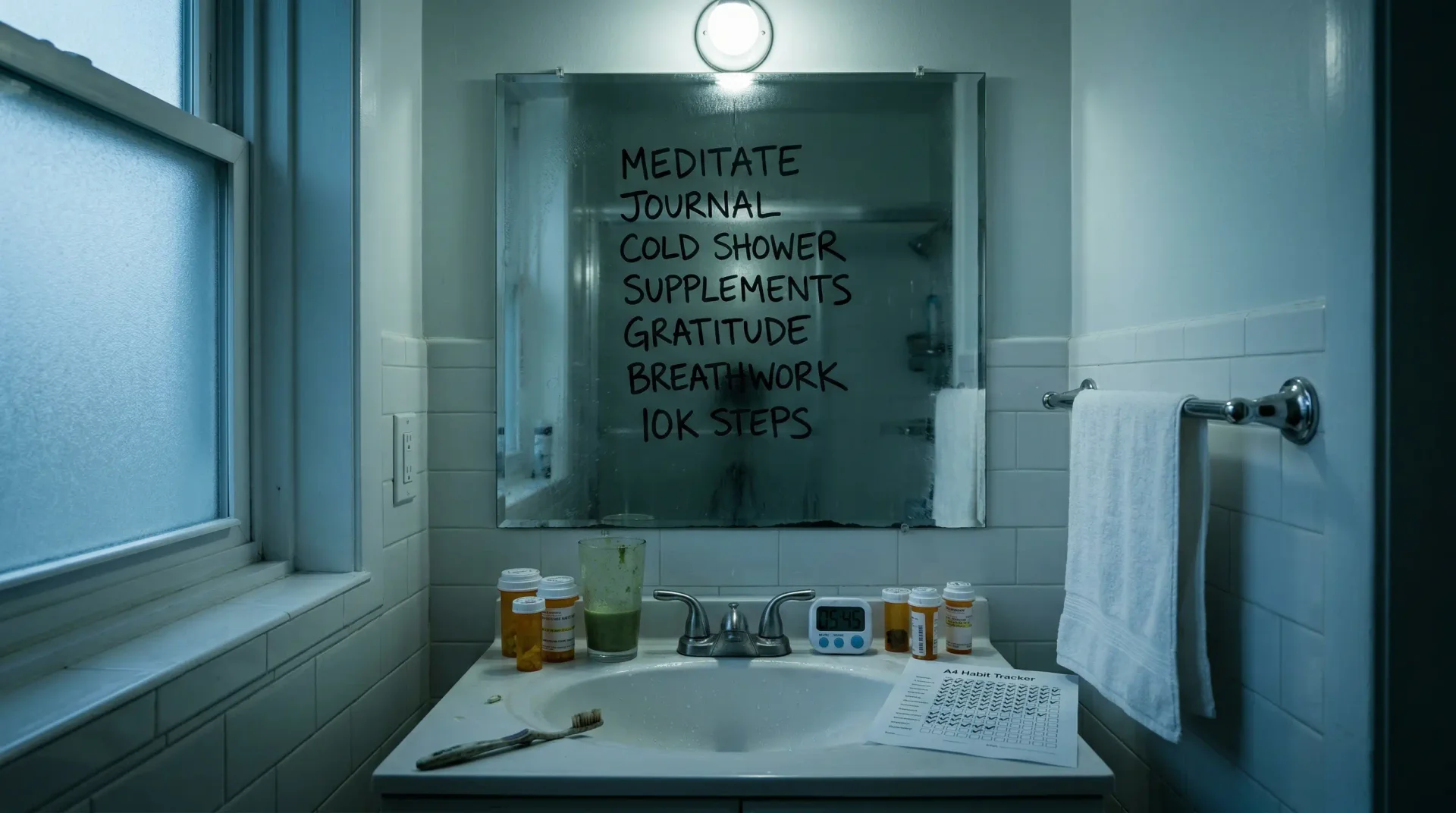
You wake up and immediately check your habit tracker. Morning meditation: ✓ Cold shower: ✓ Journaling: ✓ Green smoothie: ✓ 10 pages of reading: ✓ By 8 AM, you've already completed seven tasks designed to optimize your life. It feels productive. Until it doesn't.
Somewhere between the breathwork app and the gratitude journal, your wellness routine went from energizing to exhausting. The habit tracker that once motivated you now feels like a demanding boss. You skip a day and feel guilty. You miss a week and feel like a failure. What started as self-care became another source of stress.
This is habit burnout—and it's far more common than the wellness industry wants to admit.
The Paradox of Modern Wellness
The global wellness market hit $5.6 trillion in 2024, with meditation apps, habit trackers, and morning routine guides leading the charge. We're more informed about health and mindfulness than any generation before us. Yet anxiety rates continue climbing, burnout is at epidemic levels, and the habits designed to help us are often making things worse.
The problem isn't wellness itself. The problem is how we've been taught to pursue it.
The wellness industry sells optimization. It tells you that the key to a better life is stacking more good habits: wake at 5 AM, meditate for 20 minutes, journal three pages, exercise for an hour, read before bed. Each habit is valuable individually. But when you try to do them all—especially when you're already busy, stressed, or exhausted—you create a system designed to break.
What Habit Burnout Actually Looks Like
Habit burnout isn't just feeling tired of your routine. It's a specific pattern that develops when the systems meant to improve your life become sources of stress. Here are the warning signs:
You feel dread opening your habit tracker. What once felt motivating now triggers anxiety. You see empty checkboxes as failures rather than opportunities.
Missing a habit causes disproportionate guilt. Skip meditation one morning and your brain declares the whole day ruined. This all-or-nothing thinking turns minor slip-ups into major setbacks.
You've stopped enjoying the activities you're tracking. Journaling feels like homework. Meditation feels like another obligation. The practices you chose for joy now feel like chores.
Your routines feel rigid and joyless. There's no room for spontaneity, rest, or adaptation. Life must bend around your habits, not the other way around.
You're tracking habits to avoid feeling "lazy." The motivation shifted from "this improves my life" to "I should do this." External pressure replaced internal desire.
If these sound familiar, you're not failing at wellness. Your approach to wellness is failing you.
Why Traditional Habit Advice Sets You Up to Fail
Most habit-building advice comes from a flawed assumption: that more is better, and consistency means perfection. This creates four critical problems:
1. The Stacking Trap
Popular advice tells you to habit stack: attach new behaviors to existing ones to build routines. The concept is sound, but the execution gets out of hand quickly. You start with one habit: meditate after coffee. Then you add another: journal after meditation. Then another: read after journaling. Before you know it, your "morning routine" is 90 minutes long and requires military precision to execute.
This isn't habit stacking—it's habit hoarding. And it's unsustainable for anyone with a job, family, or life that doesn't follow a perfect schedule.
2. All-or-Nothing Thinking
Habit trackers reinforce binary success/failure. Green check mark or red X. Streak maintained or streak broken. This doesn't account for being human.
Life happens. You sleep through your alarm. You get sick. You travel. You have a morning where everything goes wrong and barely make it to work on time. Traditional habit tracking treats these inevitable moments as failures, creating guilt that makes you less likely to return to the habit, not more.
3. The Novelty Cliff
Your brain loves novelty. That's why starting a new routine feels exciting—you're riding a wave of dopamine and possibility. But novelty is designed to fade.
Research on habit formation shows that most people abandon new practices within the first three months. This isn't a willpower problem. It's when the initial enthusiasm wears off and you're left with the actual work of maintaining the habit. If your system relied on motivation to function, it collapses the moment motivation dips.
4. Losing the "Why"
You started meditating to reduce stress. Now you're stressed about meditating. You started journaling to process emotions. Now you're processing guilt about missing entries.
When habits become obligations divorced from their original purpose, burnout follows. The means become the end, and you forget why you started.
The Real Cost of Habit Burnout
The consequences of unsustainable wellness routines go beyond abandoned apps and dusty yoga mats:
Decision fatigue multiplies. Every habit requires willpower to initiate. Too many habits deplete your limited daily supply of decision-making energy, leaving you exhausted before the day truly begins.
Guilt compounds. Missing habits creates guilt. Guilt increases stress. Stress makes maintaining habits harder. You enter a negative spiral where the solution becomes the problem.
Intrinsic motivation dies. When you rely on streaks, trackers, and external validation to maintain habits, you disconnect from the actual benefits. You're no longer meditating because it calms you—you're meditating to keep a streak alive.
Flexibility vanishes. Rigid routines can't adapt to life. The moment something disrupts your schedule—a late night, a sick child, travel—you're thrown off completely, reinforcing the belief that you're "bad at habits."
The irony is painful: the habits meant to reduce stress are creating more of it. That pressure now sits inside a broader workplace mental-health collapse: our analysis of the 2026 burnout recovery data shows how many people hit the wall at work and then get almost no structured support on the way back.
A Different Approach: Sustainable Wellness Design
Sustainable wellness isn't about discipline. It's about design. Instead of forcing yourself to do more, focus on building systems that work with your life, not against it.
Principle 1: Minimums Over Maximums
Ask not "what's my ideal routine?" but "what can I do even on my worst days?"
This question changes everything. Your ideal routine might be 30 minutes of meditation, 10 pages of reading, and a full workout. Your minimum might be three conscious breaths, one paragraph of journaling, and a 5-minute walk. The minimum is what you commit to. Everything else is bonus.
Why this works: Consistency beats intensity. Two minutes daily creates more lasting change than 30 minutes weekly. By lowering the floor, you make it easier to show up—and once you're there, you often do more naturally.
Principle 2: One Anchor Habit
Forget habit stacking multiple new behaviors. Choose one anchor habit—the single practice that would make the biggest difference in your life right now.
Maybe it's a 5-minute morning meditation. Maybe it's a 10-minute walk after lunch. Maybe it's writing down one thing you're grateful for before bed. Whatever it is, commit to just this one thing until it becomes automatic.
Why this works: Willpower is finite. Spreading it across 10 habits means each gets 10% of your energy. Focusing on one gives it 100%. Master it, then consider adding another.
Principle 3: Flexible Consistency
Replace "I must do this every day" with "I aim to do this most days."
This isn't giving yourself an out—it's being realistic. Aiming for 5 out of 7 days removes the all-or-nothing pressure while maintaining strong consistency. It acknowledges that life has patterns: weekdays vs. weekends, busy seasons vs. slow ones, high energy vs. low.
Why this works: Flexibility prevents the "ruined day" effect. Miss your morning meditation? You can still do an evening session. Or tomorrow. Your practice bends without breaking.
Principle 4: Reconnect with the "Why"
For every habit you maintain, regularly ask: "Does this genuinely improve my life, or am I doing it because I think I should?"
Be honest. It's okay to let go of habits that no longer serve you, even if they're "good" habits. If journaling has become a chore and walking feels restorative, swap them. Your wellness routine should fit you, not some idealized version of you.
Why this works: Intrinsic motivation—doing things because they genuinely help—is sustainable. Extrinsic motivation—doing things for approval, streaks, or guilt—is exhausting.
Principle 5: Make It Enjoyable
If you hate your morning run, try dancing. If journaling feels like homework, voice-record your thoughts. If meditation feels boring, try mindful walking instead.
The "right" way to build a habit is the way you'll actually maintain it. There's no prize for suffering through practices you dislike. The goal is wellness, not martyrdom.
Why this works: Pleasure reinforces behavior. Habits you enjoy don't require willpower to maintain—they become things you look forward to.
Practical Recovery: Escaping Habit Burnout
If you're already burned out, here's how to recover:
Step 1: Give yourself permission to reset. Delete your habit tracker if you need to. Take a week off from structured routines entirely. The habits that truly matter will naturally return. The ones that don't weren't serving you anyway.
Step 2: Audit your current habits. List everything you're trying to maintain. For each one, rate: How much does this actually improve my life? How much stress does it cause? If the stress exceeds the benefit, consider dropping it—temporarily or permanently.
Step 3: Choose your anchor. Pick the single habit from your list that would make the biggest positive difference. Commit to just this one for the next 30 days. Set the minimum version (what you can do even on hard days) as your baseline.
Step 4: Build flexibility into the system. Create a backup plan for when your primary habit isn't possible. Can't do your full meditation? Do three conscious breaths. Can't journal three pages? Write one sentence. Can't do your full workout? Do five pushups. Something is infinitely better than nothing.
Step 5: Track differently. If you track, track what matters: how you feel, not just whether you did the habit. Did you notice feeling calmer after meditating? More focused after walking? These internal indicators matter more than external streaks.
What Sustainable Wellness Actually Looks Like
Sustainable wellness isn't a perfect routine you maintain flawlessly. It's a flexible system that adapts to your life while keeping you connected to what actually matters.
Some days you'll do your full routine. Some days you'll do the minimum. Some days you'll skip entirely—and that's okay. The goal isn't perfection. The goal is a net positive: over time, your wellness practices add more to your life than they take.
This might mean having a smaller routine that you actually maintain rather than an impressive one you abandon after three weeks. It means tracking less and living more. It definitely means being kind to yourself when things don't go perfectly.
The Deeper Shift
Beyond the practical changes, sustainable wellness requires a mindset shift:
From optimization to sufficiency. You don't need the perfect routine. You need a routine that's good enough and sustainable. Done is better than perfect.
From discipline to design. Relying on willpower is fragile. Building systems that make good habits easy is robust.
From tracking to feeling. External validation (streaks, checkmarks) is temporary. Internal awareness (how you feel, what you notice) is lasting.
From habits to practice. A habit is something you check off a list. A practice is something you return to, imperfectly, over time. Practices forgive missed days. Practices adapt. Practices last.
Building Your Sustainable System
Ready to redesign your approach? Start here:
This week: Take inventory. What's causing burnout? What genuinely helps? What can you let go of?
This month: Choose one anchor habit. Set the minimum version. Practice flexible consistency.
This quarter: Evaluate. Is this working? Do you feel better or worse? Adjust accordingly.
This year: Build slowly. Add habits only when the current ones feel automatic. Prioritize depth over breadth.
Remember: You're building habits to support your life, not building a life to support your habits.
When to Use Tools (And When to Put Them Down)
Apps and habit trackers aren't inherently bad. They're tools, and like any tool, they work best when used appropriately.
Use them when: You're building a new habit and need external accountability. You're tracking progress toward a specific goal. You're experimenting and want data on what works.
Put them down when: Checking the tracker causes stress. You feel guilty about streaks. You're more focused on the numbers than the experience. The tool has become the goal.
The best habit tracker is the one you don't need anymore—because the habit has become automatic and internally motivated.
The Real Goal
Here's what the wellness industry won't tell you: The goal isn't to have the perfect routine, the longest streak, or the most optimized morning. The goal is to live a better life.
If your habits are making you stressed, anxious, and exhausted, they're defeating their own purpose. It doesn't matter how "good" the habits are on paper. What matters is how they actually function in your life.
Sustainable wellness looks different for everyone. For some, it's a 5-minute morning meditation. For others, it's a weekly nature walk. For others, it's simply pausing to breathe deeply three times a day. There's no universal formula. There's only what works for you.
Starting Today
You don't need to overhaul your entire life. You just need to start with one small shift:
- Lower the bar on one habit to its minimum sustainable version
- Give yourself permission to miss a day without guilt
- Drop one habit that's causing more stress than benefit
- Replace one obligation with something you actually enjoy
- Spend one day without tracking anything and notice how you feel
Small changes create momentum. Momentum creates consistency. Consistency creates lasting change—not the fragile, perfect kind, but the flexible, sustainable kind that actually survives contact with real life.
Your wellness routine should be a refuge, not another source of pressure. Design it that way, and it will support you for years to come.
Related Articles
AI Daily Planner or Focus Reset: Which One Do You Need?
A calm comparison of AI daily planners and focus reset tools for people whose day keeps changing after they make the plan.
Best Focus Apps in 2026: The Quiet Stack for Deep Work
A practical guide to focus apps in 2026, built around planning, protected attention, and short resets instead of another noisy dashboard.
The Attention Economy Is Stealing Your Life (Here's How to Take It Back)
Your attention span has dropped below that of a goldfish. Here's the data on information overload and a practical system to reclaim your focus.
Ready to find your calm?
UltraVibe creates personalized meditations that adapt to your mood and schedule.
Try UltraVibe free