

Decision Fatigue Is Silently Destroying Your Productivity (And How to Stop It)
The average adult makes 35,000 decisions daily. By afternoon, your decision quality plummets. Here's how mindfulness restores cognitive clarity.
Daily Zen Team
UltraVibe
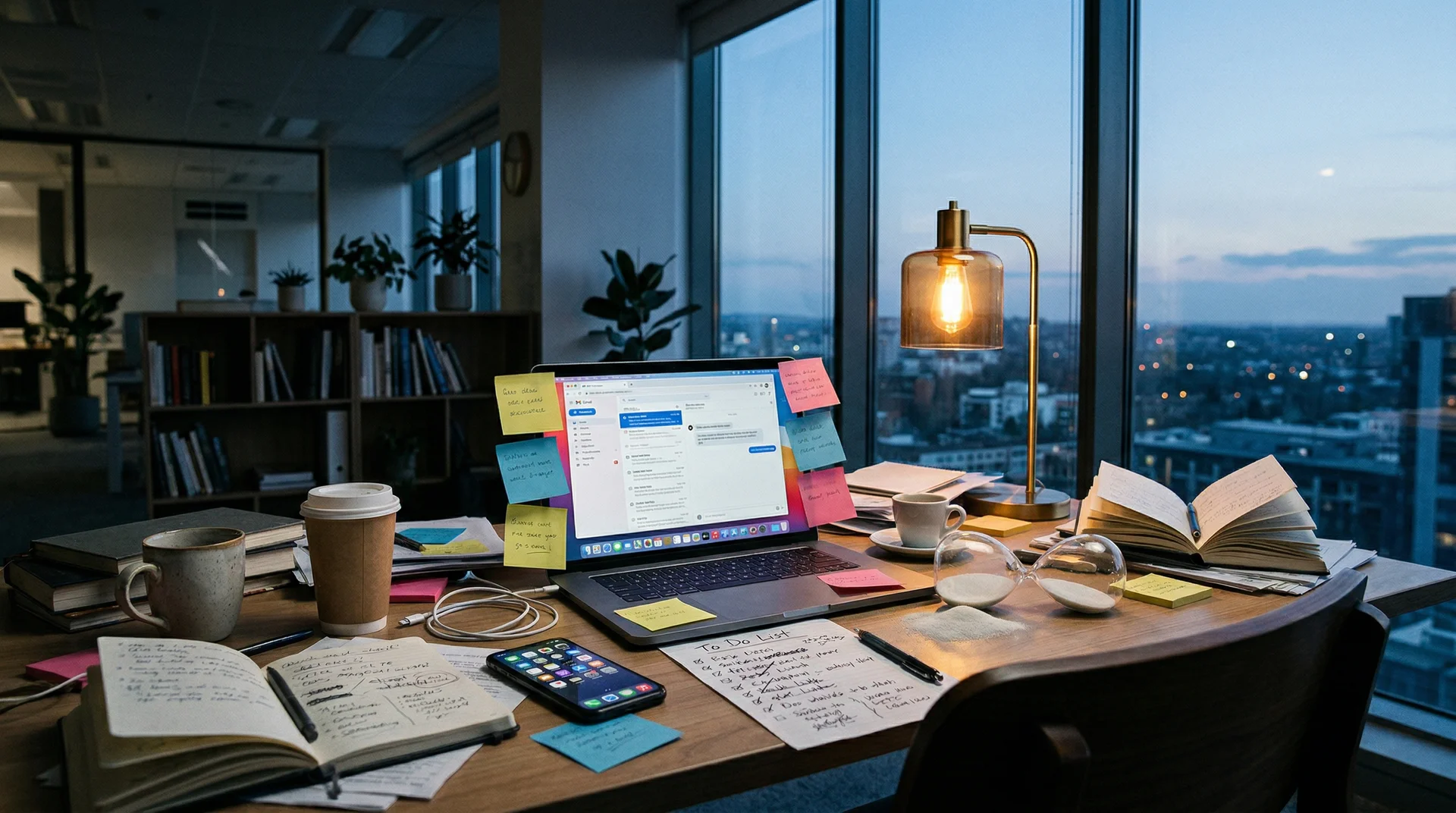
Quick answer: Decision fatigue is the drop in judgment quality that happens after too many choices, interruptions, and context switches. If your afternoon productivity keeps collapsing, the fastest fix is to reduce decision load and use a 60-second mindfulness reset before the next important choice.
At a glance:
- 35,000 decisions/day: the average adult's total decision load
- 23+ minutes: time it can take to fully refocus after an interruption
- 60% of the workday: lost to coordination and work-about-work
- 30% of the day: spent searching for information
Decision fatigue is rarely one big decision. It is usually the stack of interruptions, routing choices, and context switching that drains judgment before deep work even starts.
You've been there. It's 3 PM. Your to-do list still has twelve items. You've already made a hundred tiny choices today—what to eat, which email to answer first, whether that Slack message needs an immediate response—and now you can't even decide what to work on next.
You stare at your screen. Open Twitter. Close it. Check email again. Make coffee you don't need. Spend twenty minutes on a task that should take five.
This isn't laziness. This isn't procrastination, exactly. This is decision fatigue—and it's one of the most underrecognized productivity killers in modern work.
The Scale of the Problem
Research tells us the average adult makes approximately 35,000 decisions every single day. Most are unconscious: which sock goes on first, whether to step over that crack in the sidewalk. But thousands are deliberate choices that consume mental energy.
For knowledge workers, the burden is extraordinary:
- 120 work messages received daily on average
- Interruptions every 3-11 minutes, requiring 23+ minutes to fully refocus
- 60% of the workday spent on "work-about-work" (email, status updates, coordination) rather than focused work
- 30% of the day searching for information
Every notification is a micro-decision: check or ignore? Every email requires prioritization. Every Slack message demands an assessment of urgency.
Your brain has finite cognitive resources. The more decisions you make, the more depleted those resources become. Decision fatigue isn't a metaphor—it's as real as physical exhaustion.
The Science Behind Cognitive Depletion
Decision fatigue is grounded in the Strength Model of Self-Control developed by psychologist Roy Baumeister. The model proposes that self-control operates like a muscle: using it depletes a limited reservoir of mental energy.
Each decision draws from this reservoir. The more decisions you make, the harder each subsequent decision becomes. Eventually, the quality of your choices deteriorates dramatically.
This isn't speculative psychology. The evidence is striking.
The Parole Study That Changed Everything
In 2011, researchers analyzed 1,112 parole decisions made by eight Israeli judges over ten months. The judges reviewed cases in sessions, with breaks for food.
The results were shocking:
- Early morning decisions: 70% of parole requests granted
- Late afternoon decisions: Only 10% granted
Same judges. Same cases. The only variable was timing—and the judges' accumulated decision fatigue.
After a meal break, the favorable ruling rate jumped back to 65%. Then it declined again as the session wore on.
These were experienced legal professionals making life-altering decisions. If decision fatigue affects them this dramatically, what is it doing to your work?
How Decision Fatigue Manifests
Decision fatigue doesn't announce itself. It creeps in gradually, and its symptoms are often misattributed to other problems:
Behavioral Signs
- Procrastination: Delaying decisions that feel overwhelming
- Impulsivity: Making rash choices with little analysis
- Avoidance: Ignoring decisions entirely, hoping they'll resolve themselves
- Default bias: Choosing whatever option requires least thought, regardless of quality
Cognitive Signs
- Analysis paralysis: Overthinking simple choices, cycling through options without resolution
- Cognitive shortcuts: Relying on heuristics and mental shortcuts instead of proper evaluation
- Loss of executive function: Reduced ability to plan, organize, and execute complex tasks
- Attention residue: Part of your mind remains stuck on previous decisions even as you try to focus on new ones
Physiological Signs
- Mental fog and difficulty concentrating
- Physical fatigue disproportionate to activity level
- Tension headaches, particularly in temples and jaw
- Irritability and emotional volatility
- Sleep problems
Decision fatigue is cumulative. It worsens as the day progresses. And in modern work environments—characterized by constant communication, unclear priorities, and endless micro-decisions—it's becoming endemic. If your version of cognitive overload now comes from managing too many AI tools and agent notifications at once, read our companion guide on AI tool fatigue and how to regain focus, especially the fast diagnosis section for spotting overlap and alert-driven overload before it eats the whole day. And if the overload shows up less as bad prioritization and more as a brain that will not stop running when you try to reset, pair this with our guide to meditating when your brain won't shut up for more active, racing-thought-friendly techniques.
The Economic Impact
Decision fatigue isn't just a personal problem. It has staggering economic consequences.
Research from Basex estimates that information overload and decision fatigue cost the U.S. economy $900 billion annually in lost productivity. This figure reflects approximately 25% of knowledge worker capacity lost to managing information rather than doing meaningful work.
More personally:
- 80% of knowledge workers report feeling overworked and close to burnout
- 62% experience imposter syndrome, amplified by poor decision-making under fatigue
- 59% report feeling disengaged at work
- Knowledge workers switch between 10 tools up to 25 times daily, fragmenting attention
The modern work environment is structurally designed to induce decision fatigue—and most organizational responses make it worse.
Why Common Advice Fails
You've heard the standard prescriptions: batch your decisions, limit choices, automate routine selections. These aren't wrong, but they treat symptoms rather than causes.
The deeper problem is that modern work has fundamentally misaligned incentives with cognitive capacity.
Expectations of instant responsiveness create endless decision demands. Ambiguous priorities force constant reprioritization. Organizational structures require constant coordination via multiple channels (email, Slack, Teams, project management tools, video calls).
Individual productivity techniques can't fix structural problems. While streamlining your wardrobe and meal planning help at the margins, they don't address the 120 daily messages, the constant interruptions, or the expectation of availability outside work hours.
The Mindfulness Connection
Here's where mindfulness enters the picture—not as a productivity hack, but as a cognitive reset mechanism.
Decision fatigue depletes executive function. Mindfulness restores it.
Research on mindfulness meditation shows several relevant effects:
Attention Restoration
Mindfulness practice strengthens the prefrontal cortex, the brain region responsible for executive function and decision-making. Regular practice increases gray matter density in areas associated with attention and emotional regulation.
Importantly, even brief mindfulness interventions show effects. Studies have found that short mindful breathing exercises restore cognitive resources depleted by demanding tasks.
Stress Reduction
Cortisol and adrenaline impair decision-making. They narrow attention and bias choices toward immediate gratification rather than long-term benefit.
Mindfulness reduces cortisol levels and activates the parasympathetic nervous system—shifting the body from "fight or flight" to "rest and digest." This physiological reset directly counteracts the stress that accelerates decision fatigue.
Metacognitive Awareness
Decision fatigue is often invisible. You don't notice your declining judgment until you've made a significant error.
Mindfulness develops metacognitive awareness—the ability to observe your own mental states. This awareness lets you recognize decision fatigue before it compromises important choices.
Practical Mindfulness Interventions for Decision Fatigue
The research supports three specific applications:
Micro-Practices Between Decisions
Brief mindfulness breaks—60 seconds or less—restore cognitive resources depleted by demanding tasks.
After a difficult decision or intense focus period, pause for sixty seconds. Close your eyes. Breathe naturally. Notice the sensation of air entering and leaving your nostrils. When your mind wanders—and it will—gently return attention to the breath.
This isn't meditation in the traditional sense. It's a cognitive palate cleanser. Research shows it measurably restores attention and reduces cortisol.
Pre-Decision Rituals
Before making significant decisions, establish a brief mindfulness practice. Three to five minutes of focused breathing creates space between stimulus and response—allowing executive function to engage fully.
This practice counteracts the impulsivity that decision fatigue induces. It restores the ability to evaluate trade-offs and consider long-term consequences.
End-of-Day Restoration
Decision fatigue accumulates throughout the day. Evening mindfulness practice—10-20 minutes—allows the nervous system to shift from sympathetic (activated) to parasympathetic (restorative) dominance.
This shift is critical for next-day performance. Sleep quality improves. Morning cortisol patterns normalize. Decision-making capacity replenishes.
When to Practice
Timing matters. Mindfulness interventions are most effective when deployed strategically:
Morning: Brief practice (2-5 minutes) before beginning work primes attention and buffers against early decision load. If you want a concrete version instead of generic advice, use this 10-minute morning routine backed by science.
Between tasks: Micro-practices (60 seconds) after completing cognitively demanding work restore resources before the next demand.
Pre-meeting: Two minutes of breathing before important meetings clears attention residue and optimizes present-moment focus.
Decision thresholds: When facing significant choices, pause first. The impulse to decide immediately often signals decision fatigue rather than clarity.
Afternoon slump: 3 PM is when decision fatigue peaks for most people. This is when mindfulness intervention is most valuable—and when it's least likely to happen without intentional structure.
The Deeper Pattern
Decision fatigue is a symptom of deeper dysfunction: the assumption that human attention is infinitely elastic, that productivity is a linear function of time invested, that constant availability demonstrates commitment.
None of these assumptions are true. Humans are biological systems with finite resources. Attention depletes. Decision quality degrades. Recovery is mandatory, not optional.
Mindfulness doesn't solve structural problems. It won't reduce your meeting load or clarify ambiguous priorities. But it restores the cognitive capacity to navigate these challenges more effectively.
What This Looks Like in Practice
Consider Sarah, a product manager at a mid-sized tech company. Her day starts at 8 AM with Slack notifications. By 10 AM, she's made 50+ micro-decisions. By 2 PM, she's staring at a product requirements document, unable to choose which feature to prioritize.
She used to push through. Drink more coffee. Check email again. End days exhausted, with important decisions deferred to tomorrow.
Now she does something different. At 9:30 AM, after her standup, she takes 60 seconds—one minute—of focused breathing. At 11:30, another minute. At 2 PM, when the decision fatigue hits hardest, she pauses again.
These aren't breaks from work. They're restoration for work. Three minutes total. The difference between reactive and intentional. Between depleted and capable.
The Cost of Inaction
Decision fatigue compounds. Poor decisions create problems requiring more decisions. Avoided decisions grow more complex with delay. Impulsive choices generate consequences demanding correction.
The cost isn't just productivity. It's the cumulative effect of suboptimal choices in careers, relationships, health, and finances—decisions made not from clarity but from cognitive depletion.
60 seconds of mindfulness is a small investment against these costs. The research is clear: brief attention restoration measurably improves decision quality, reduces stress, and prevents the cascade of consequences that decision fatigue produces.
Decision Fatigue FAQ
What is decision fatigue?
Decision fatigue is the decline in decision quality that happens after repeated choices, interruptions, and cognitive load. It often shows up as procrastination, impulsive choices, second-guessing, or defaulting to whatever feels easiest.
Why does decision fatigue hurt productivity?
Decision fatigue hurts productivity because every micro-decision consumes attention that should go toward actual work. By afternoon, many people are no longer solving the highest-value problem. They are managing messages, switching tools, and recovering from interruption residue.
Can mindfulness actually reduce decision fatigue?
Mindfulness helps reduce decision fatigue because it restores attention, lowers stress reactivity, and improves awareness of when your judgment is degrading. Even a 60-second breathing reset can create enough space to make the next decision more intentionally.
When is decision fatigue worst?
Decision fatigue is usually worst later in the day, especially after a morning full of notifications, meetings, and context switching. It tends to peak when people have been responsive all day and have not taken any cognitive reset between tasks.
What should I do when decision fatigue hits at work?
Start by reducing incoming decisions for a short window: silence notifications, stop checking inboxes, and identify the single next task that matters most. Then use a brief mindfulness reset. If your overload is anxiety-driven, pair this with our guide on meditation for workplace anxiety, especially the quick chooser for meeting stress vs inbox dread vs body tension. If your nervous system is stuck in overdrive from communication overload, read email anxiety and mindfulness.
Final Note
This isn't about becoming a meditation practitioner. It's about understanding how your mind works—and working with it rather than against it.
Decision fatigue is real. It's measurable. It affects everyone's judgment, regardless of intelligence or experience. The question isn't whether you're experiencing it. The question is what you're doing about it.
A minute of mindfulness won't solve everything. But it will restore enough clarity to make your next decision well. And that's how progress happens: not through perfect systems, but through slightly better choices, made consistently, over time.
Daily Zen provides structured 60-second mindfulness breaks designed specifically for busy professionals. When decision fatigue hits, you don't need another app to manage—you need a moment of clarity. That's what we provide. If you want a more personalized version of that reset, start with our explainer on what AI meditation actually is or compare the old library model against adaptive practice in why meditation apps fail.
Related Articles
AI Daily Planner or Focus Reset: Which One Do You Need?
A calm comparison of AI daily planners and focus reset tools for people whose day keeps changing after they make the plan.
Best Focus Apps in 2026: The Quiet Stack for Deep Work
A practical guide to focus apps in 2026, built around planning, protected attention, and short resets instead of another noisy dashboard.
The Attention Economy Is Stealing Your Life (Here's How to Take It Back)
Your attention span has dropped below that of a goldfish. Here's the data on information overload and a practical system to reclaim your focus.
Ready to find your calm?
UltraVibe creates personalized meditations that adapt to your mood and schedule.
Try UltraVibe free