

Email Anxiety: Why Your Inbox Feels So Heavy (And How Mindfulness Helps)
Email anxiety can look like dread, racing thoughts, and after-hours checking. Here's how mindfulness helps you handle work email without carrying it all day.
Daily Zen Team
UltraVibe
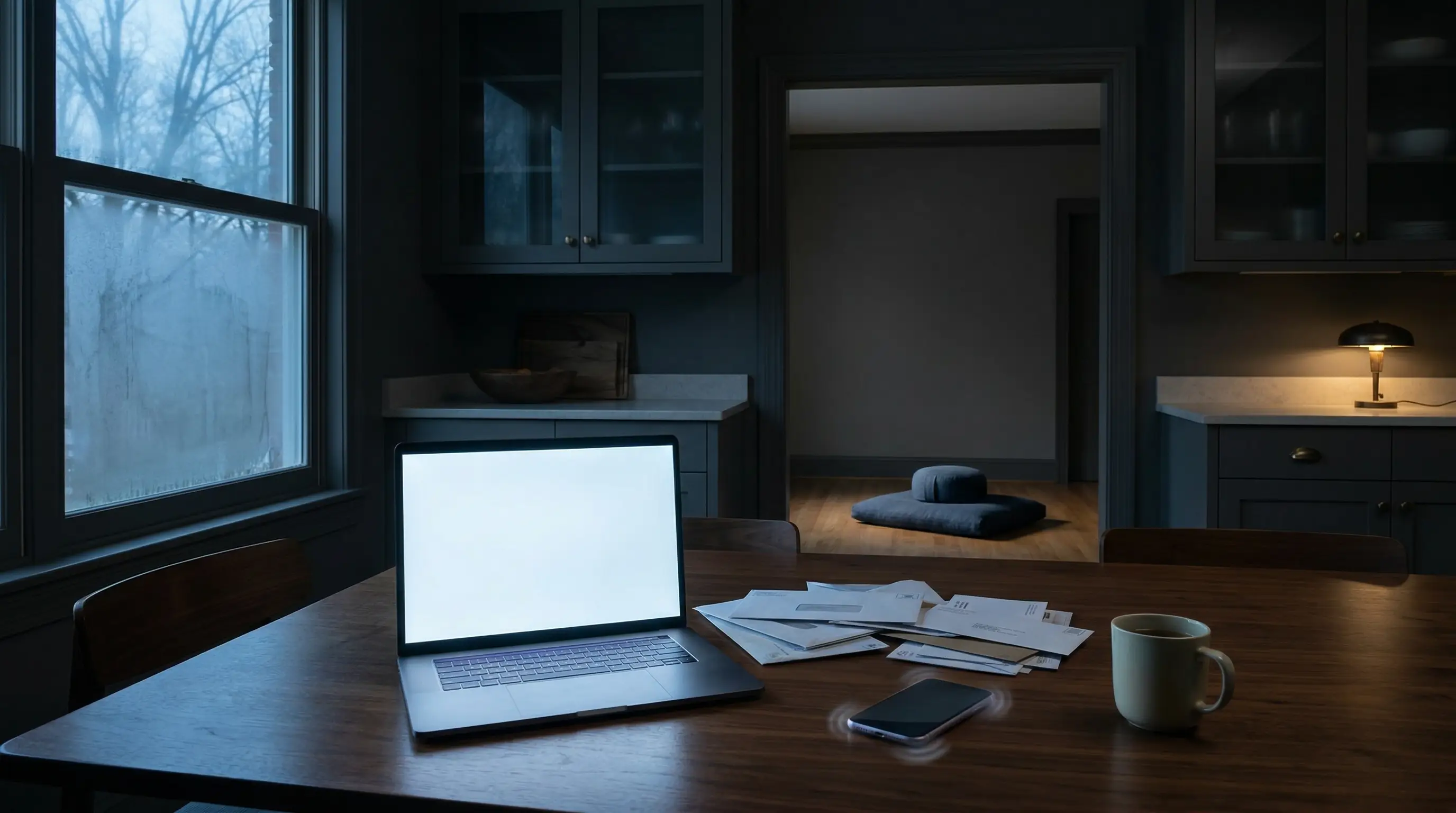
Email anxiety is the stress response people feel before, during, or after checking work email. Common email anxiety symptoms include dread before opening your inbox, racing thoughts after difficult messages, sleep disruption, and a constant urge to check for what might be waiting.
If you are trying to figure out how to deal with email anxiety, mindfulness will not reduce your inbox volume. What it can do is reduce reactivity, restore boundaries, and help work email anxiety feel less physically consuming. And if generic meditation apps keep feeling emotionally off for this kind of situational stress, our Headspace vs Calm vs AI meditation comparison explains why generated guidance can fit messy work moments better than a recorded library.
- Most common triggers: uncertainty, after-hours expectations, inbox overload, and emotionally charged messages
- What mindfulness helps with: nervous-system regulation, pause-before-reply behavior, and cleaner work/rest boundaries
- When self-help is not enough: panic attacks, severe sleep disruption, or anxiety that keeps spilling into the rest of your life
Jump to: what to do right now · symptoms and stats · why email triggers anxiety · the mindfulness approach · faq
How to Deal With Email Anxiety Right Now
If work email anxiety is already active, do not start with productivity hacks. Start by reducing arousal in your body, then shrink the uncertainty loop that makes inbox stress spiral.
| When you notice email anxiety | What to do | Why it helps | |---|---|---| | Before opening your inbox | Take 3 slow breaths and name what you expect to find | Naming the fear reduces vague anticipatory stress | | After a difficult message lands | Wait 30 minutes before replying if possible | A pause lowers the odds of reactive responses | | When the inbox feels bottomless | Batch for 25-30 minutes and decide on each message once | Decision clarity lowers helplessness | | When work follows you home | Set a hard stop time and use a short evening practice | Boundaries protect sleep and recovery |
If the dread is strongest in the first check-in of the day, pair this with our 10-minute morning routine backed by science. If it keeps bleeding into general overstimulation, read how AI tool fatigue quietly wrecks your focus. If your brain feels noisy long after the laptop closes, use 90 seconds of meditation to interrupt the first wave of panic.
What Email Anxiety Looks Like in Practice
| Trigger | Practice | Why it works | |---|---|---| | You wake up and want to check overnight messages immediately | Delay your first inbox check until after 3 breaths and one grounding action | It stops your morning cortisol spike from latching onto new email ambiguity | | A hard message lands and you feel heat in your body | Draft notes privately, then wait 30 minutes before replying | It creates space between emotional activation and the social risk of a rushed response | | Your inbox feels bottomless by mid-afternoon | Run one 25-minute triage block and decide on each message once | Single-pass decisions reduce learned helplessness and open-loop fatigue | | Work follows you into the evening | Set a firm inbox cutoff and use a short wind-down meditation | Recovery starts when your body stops expecting one more message |
You feel it before you even open your laptop. That tightness in your chest. The quickened pulse. The barely-conscious urge to check your phone "just in case"—even though you checked it eight minutes ago.
Email anxiety isn't a personal failing. It's a documented, measurable phenomenon affecting the vast majority of knowledge workers. And the numbers are staggering.
Email Anxiety Symptoms: The Scale of the Problem
A comprehensive 2024 survey of 1,125 American workers by EmailTooltester.com revealed the psychological toll of digital workplace communication:
78.7% of workers have experienced dread when opening their work email inbox. Not occasional annoyance. Dread. And for 58.5% of respondents, this feeling is a regular occurrence.
80.8% report feeling anxious about work email correspondence, with more than half (58.3%) experiencing this anxiety regularly.
Two-thirds of workers (67%) have lost sleep over work emails. The burden falls heaviest on leaders—81.1% of business owners and CEOs report email-related sleep loss, compared to 63.2% of entry-level employees.
These aren't abstract statistics. They represent millions of people starting their days with cortisol spikes, ending their nights with racing thoughts, and spending their workdays in a state of low-grade panic. If the anxiety shows up less in your inbox and more in meetings, Slack, or your boss's "got a minute?" messages, read our desk-friendly guide to meditation for workplace anxiety. If the dread peaks on Sunday night before the week begins, pair this with our guide to beating the Sunday scaries with meditation. And if your real sticking point is that you sit down to meditate and your mind immediately accelerates, read how to meditate when your brain won't shut up.
Why Email Triggers Anxiety
Understanding the mechanics of email anxiety helps explain why traditional productivity advice—"just check it less often" or "unsubscribe from newsletters"—often fails.
The Uncertainty Loop
Email operates on variable reinforcement, the same psychological mechanism that makes slot machines addictive. You never know what awaits when you open your inbox. A simple request? An urgent crisis? A passive-aggressive message from your boss? The unpredictability keeps your nervous system in a state of vigilance.
Research from the University of California, Irvine found that the average knowledge worker is interrupted every 3 minutes. It then takes approximately 23 minutes to fully refocus. But email doesn't just interrupt your work—it creates what business professor Sophie Leroy calls "attention residue." Even when you're not actively checking email, part of your cognitive resources remain stuck thinking about what might be waiting for you.
The Always-On Expectation
81.4% of workers have work emails or communication platforms on their phones. 71.1% feel expected to respond to emails after hours. And perhaps most tellingly, 75.8% believe responding to emails outside work hours is necessary for career advancement.
This creates a psychological trap. Even when you're not working, part of your brain is. The boundary between work and rest dissolves, and with it, your ability to truly recover.
The Volume Problem
The average worker receives 32 emails per day. Half of respondents in the EmailTooltester survey spend three hours or more on digital work communications daily. One in ten spends five hours or more.
Yet here's what makes this truly maddening: workers believe that only 41.7% of their work emails are actually relevant to them. One-third think more than half their inbox is irrelevant.
You're drowning in communication that mostly doesn't matter, but you can't distinguish the signal from the noise without checking everything. It's the perfect recipe for learned helplessness.
The Physical Cost
Email anxiety isn't just uncomfortable—it has measurable physical and cognitive consequences:
Sleep disruption: 67% of workers lose sleep over emails. Poor sleep impairs decision-making, emotional regulation, and memory formation.
Increased errors: 68.9% of workers make email mistakes multiple times per week. 27.6% make at least one mistake daily. The very anxiety about getting things wrong makes getting things wrong more likely.
Relationship strain: 73.6% of workers report communicating less with loved ones due to burnout from work communications. Your inbox is literally stealing your relationships.
Cognitive load: The average person has 71 unread emails looming across personal and work inboxes. Each one represents an open loop, a task your brain is trying to track. This background mental load reduces your capacity for deep, creative work—the work that actually matters.
How to Deal With Email Anxiety at Work: The Mindfulness Approach
Mindfulness won't magically reduce your email volume. But it can fundamentally change your relationship with digital communication. Here's how:
Practice Email Batching
The research is clear: constant inbox monitoring destroys productivity and wellbeing. Instead of keeping email open all day, schedule specific times to process it.
Start with three sessions: mid-morning, after lunch, and late afternoon. Close your email client completely between these windows. Turn off notifications. If something is genuinely urgent, people will find another way to reach you.
The key is treating these sessions as focused tasks, not as breaks from "real work." Set a timer for 25-30 minutes. Process emails completely—respond, delete, delegate, or defer. When the timer ends, close email and move on.
Create Transition Rituals
The most stressful moments are often the transitions: opening email for the first time, switching from deep work to email processing, closing your laptop at day's end.
Build small rituals around these transitions:
Before opening email: Take three deep breaths. Set an intention for this session ("I will process efficiently and not let difficult messages derail my mood"). Remind yourself that your worth is not determined by your inbox.
After closing email: Physically close your laptop or stand up from your desk. Take 60 seconds to notice your body. Stretch. Acknowledge that you've completed this task and are now transitioning to the next thing.
These rituals serve as cognitive boundaries, helping your nervous system shift gears rather than remaining in a perpetual state of semi-activation.
Respond, Don't React
Email anxiety often stems from reactive patterns. A difficult message arrives, and you immediately feel a surge of emotion—defensiveness, anger, anxiety. You fire off a response that escalates the situation, or you freeze and avoid the message entirely, letting it fester.
Mindfulness creates space between stimulus and response. When you encounter a challenging email:
-
Notice the physical sensation. Where do you feel it? Tight chest? Clenched jaw? Racing heart?
-
Name the emotion. "I'm feeling defensive." "I'm feeling overwhelmed." "I'm feeling criticized." Naming reduces the intensity.
-
Pause before responding. For emotionally charged messages, wait at least 30 minutes. For truly difficult situations, sleep on it. The message will still be there tomorrow, and your response will be more skillful.
This practice isn't about suppressing emotions—it's about not letting them drive your behavior.
Reframe the Narrative
Much of email anxiety comes from the stories we tell ourselves:
- "If I don't respond immediately, they'll think I'm incompetent."
- "This angry message means I've failed."
- "I'll never get through all of this."
Mindfulness helps you recognize these as thoughts, not facts. When you notice anxiety arising, ask:
- "Is this thought true?"
- "Is it helpful?"
- "What would I tell a friend in this situation?"
The 2024 EmailTooltester research found that 65.1% of workers have gotten into trouble over a significant email mistake. But that means 34.9% haven't—and even those who have survived. The catastrophic outcomes we fear rarely materialize.
Practice Email Meditation
This sounds paradoxical, but you can transform email processing into a mindfulness practice:
-
Single-task. Don't have email open while on calls or in meetings. Give it your full attention.
-
Notice urges. When you feel the pull to check email outside your scheduled times, notice it. Where do you feel it? What triggered it? Often it's boredom, anxiety, or habit—not genuine necessity.
-
Touch each email once. Make a decision: respond, delete, delegate, or defer to a specific time. Don't leave it in your inbox as a mental bookmark.
-
End with closure. When your email session is complete, look at your inbox. Acknowledge what you've processed. Give yourself credit for the work.
Protect Your Off-Hours
Remember those statistics: 74.5% of workers take work laptops on vacation. 54.3% regularly answer work emails while on holiday. 71.1% feel expected to respond after hours.
This isn't sustainable. And for most workers, it's not actually required—it's perceived expectation.
Try an experiment: Don't check email after 6 PM for one week. Notice what happens. Does your work suffer? Or do you sleep better, feel more present with loved ones, and return to work more refreshed? If your mornings are where inbox stress hits hardest, a short 10-minute morning routine backed by science can make the first check-in feel less like a cortisol ambush.
If your workplace genuinely requires 24/7 availability, that's a structural problem that mindfulness alone can't solve. But for most people, the "expectation" exists primarily in their own minds.
If you need something even smaller than a full mindfulness session, use our 90 second meditation guide for those moments when the goal is simply to interrupt the first wave of inbox panic before it becomes your whole evening.
Use Technology Mindfully
Ironically, technology can help create boundaries:
-
Scheduled send: Write emails whenever inspiration strikes, but schedule them to send during business hours. This respects others' boundaries and reduces the pressure for immediate response.
-
Out-of-office messages: Use them not just for vacation, but for focused work periods. "I'm in deep work until 2 PM and will respond to emails then."
-
Filters and rules: Automate the sorting of low-priority emails so they don't demand attention.
-
Email apps with mindfulness features: Some apps now include breathing exercises or prompts to pause before sending emotionally charged messages.
Building a Sustainable Practice
Like any mindfulness practice, changing your relationship with email requires consistency and patience. Start with one change:
Week 1: Schedule three email sessions per day. Close email between them.
Week 2: Add the 3-breath ritual before opening email.
Week 3: Implement the 30-minute pause before responding to difficult messages.
Week 4: Stop checking email after a specific time (6 PM, 8 PM—whatever works for your life).
Track how you feel. Notice changes in your sleep, your relationships, your overall anxiety levels. The goal isn't inbox zero—it's inbox peace.
When to Seek Additional Support
For some people, email anxiety is part of a broader pattern of anxiety that requires professional support. Consider speaking with a therapist if:
- Email anxiety is significantly impacting your sleep, relationships, or physical health
- You're experiencing panic attacks related to work communication
- You're avoiding necessary communication due to anxiety
- The strategies above haven't provided relief after consistent practice
There's no shame in seeking help. The workplace communication burden has increased dramatically in recent years, and many people are struggling. You don't have to solve this alone.
Email Anxiety FAQ
Is email anxiety real?
Yes. Email anxiety is a real stress response tied to uncertainty, workload, social evaluation, and after-hours expectations. In the EmailTooltester survey cited above, most workers reported anxiety, dread, or sleep disruption related to work email.
What are common email anxiety symptoms?
Common email anxiety symptoms include dread before checking your inbox, racing thoughts after a difficult message, trouble sleeping, repeated checking, and physical tension such as a tight chest or clenched jaw.
How do I stop feeling anxious about work email?
Start with a short pause before opening your inbox, batch email into fixed windows, and delay emotionally charged replies long enough for your nervous system to settle. Mindfulness helps most when it changes your response pattern, not just your thinking.
Can mindfulness actually help with work email anxiety?
Yes, because mindfulness targets the part of the cycle you can control: reactivity. It will not reduce the number of emails you receive, but it can reduce panic, improve boundaries, and make difficult messages feel less physically overwhelming.
Sources
- EmailTooltester — The impact of work emails on stress, sleep, and burnout
- University of California, Irvine — Research on workplace interruptions and refocus time
- Sophie Leroy — Why is it so hard to do my work? The challenge of attention residue when switching between work tasks
The Bigger Picture
The email anxiety epidemic isn't an individual problem—it's a systemic one. Organizations have adopted digital communication tools without establishing norms that protect employee wellbeing. The expectation of constant availability serves neither productivity nor mental health.
But while we wait for systemic change, we can take individual action. Mindfulness won't fix a broken system, but it can help you navigate it with more skill and less suffering. It also explains why generic meditation libraries so often fall short: when stress is tied to a specific moment, broad recorded sessions can feel emotionally off. We unpack that problem in why most meditation apps fail.
The research is clear: 90.4% of workers believe a "right to disconnect" law would be beneficial. People are hungry for boundaries, for rest, for the ability to be fully present in their non-work lives.
Your inbox will never be empty. But your mind can be peaceful anyway. That's the practice.
Daily Zen helps you build mindfulness habits that actually fit the moment you are in. Instead of forcing you to browse a static meditation library while already stressed, Daily Zen generates short guided sessions for the exact situation: before email, after a difficult message, or when work has followed you into the evening.
Related Articles
AI Daily Planner or Focus Reset: Which One Do You Need?
A calm comparison of AI daily planners and focus reset tools for people whose day keeps changing after they make the plan.
Best Focus Apps in 2026: The Quiet Stack for Deep Work
A practical guide to focus apps in 2026, built around planning, protected attention, and short resets instead of another noisy dashboard.
The Attention Economy Is Stealing Your Life (Here's How to Take It Back)
Your attention span has dropped below that of a goldfish. Here's the data on information overload and a practical system to reclaim your focus.
Ready to find your calm?
UltraVibe creates personalized meditations that adapt to your mood and schedule.
Try UltraVibe free